
guide
Sentimental gift ideas that do not tip into cheesy
Sentimental gifts work when they are true. They flop when they perform emotion with stock phrases. Aim for honest specifics.
Updated
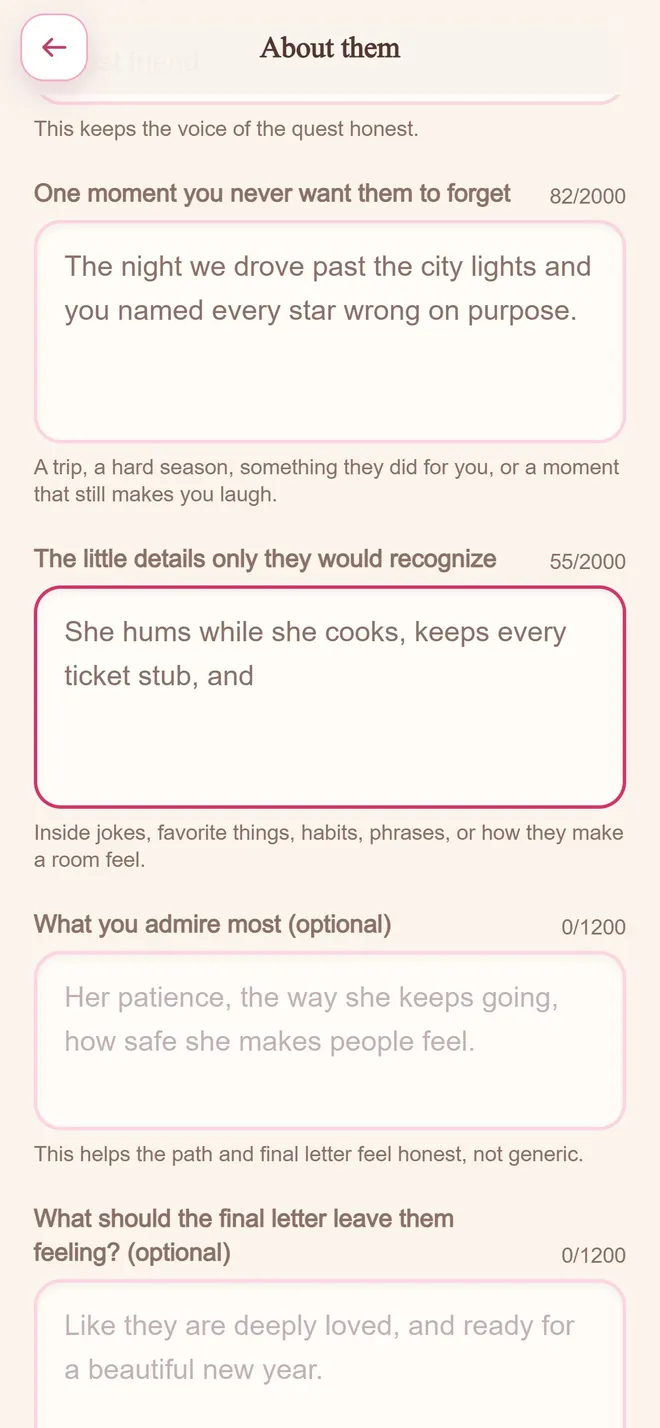

The memories only you know
step 02 · the brief
Sentiment is evidence
Show care by citing moments: what they did, what it meant, what you remember that they might have forgotten. Evidence reads as love; vague adjectives read as filler.
Choose a vessel
A private interactive quest, a letter, a photo timeline, or a small object with a strong note. BloomQuest: Celebrate helps when you want structured scenes rather than one long paragraph.
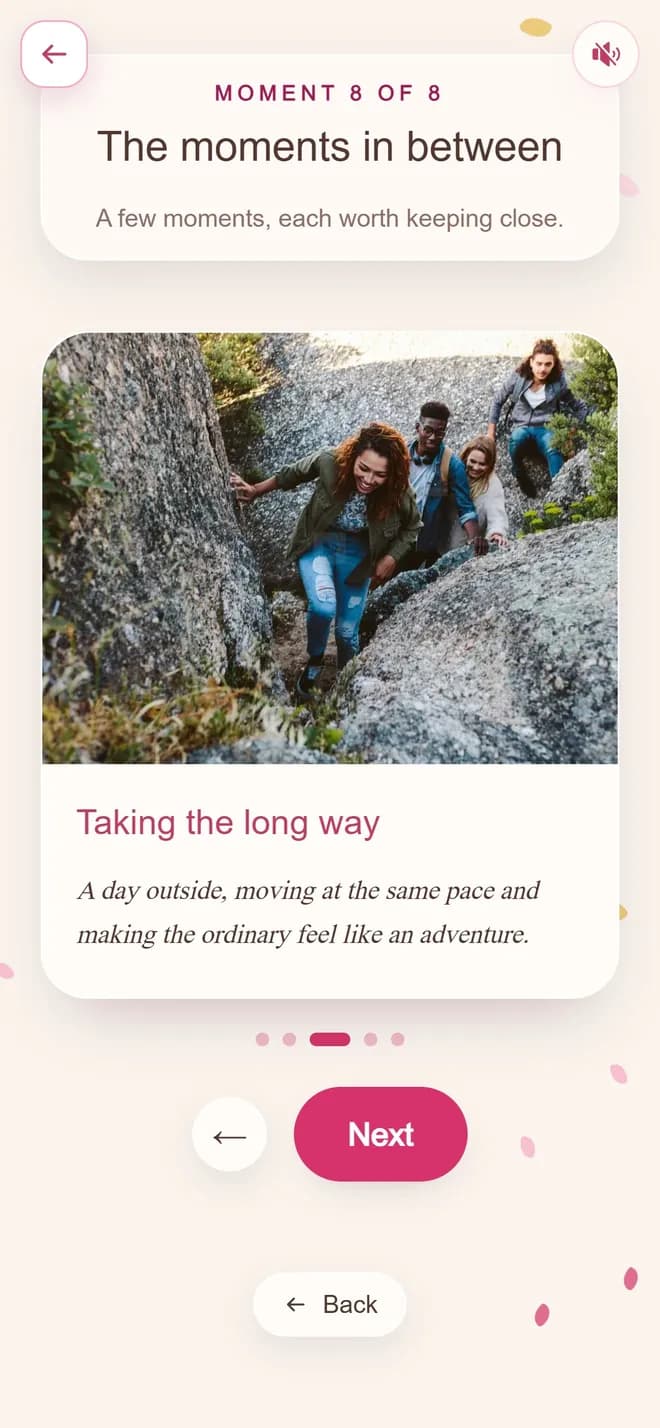
The moments in between
moment 8 of 8 · your photos
Edit for your real voice
If a line would embarrass you to say out loud, cut it. Warm and specific beats poetic and false.
Matching intensity to the relationship
A gift for a five-year relationship and a gift for a new friendship should not use the same emotional register. Overreaching for a newer or lighter relationship is one of the fastest ways to tip sincere into uncomfortable.
When in doubt, write slightly less intensely than you feel and let the specific details carry the weight instead. Restraint paired with real detail almost always outperforms full intensity with generic phrasing.
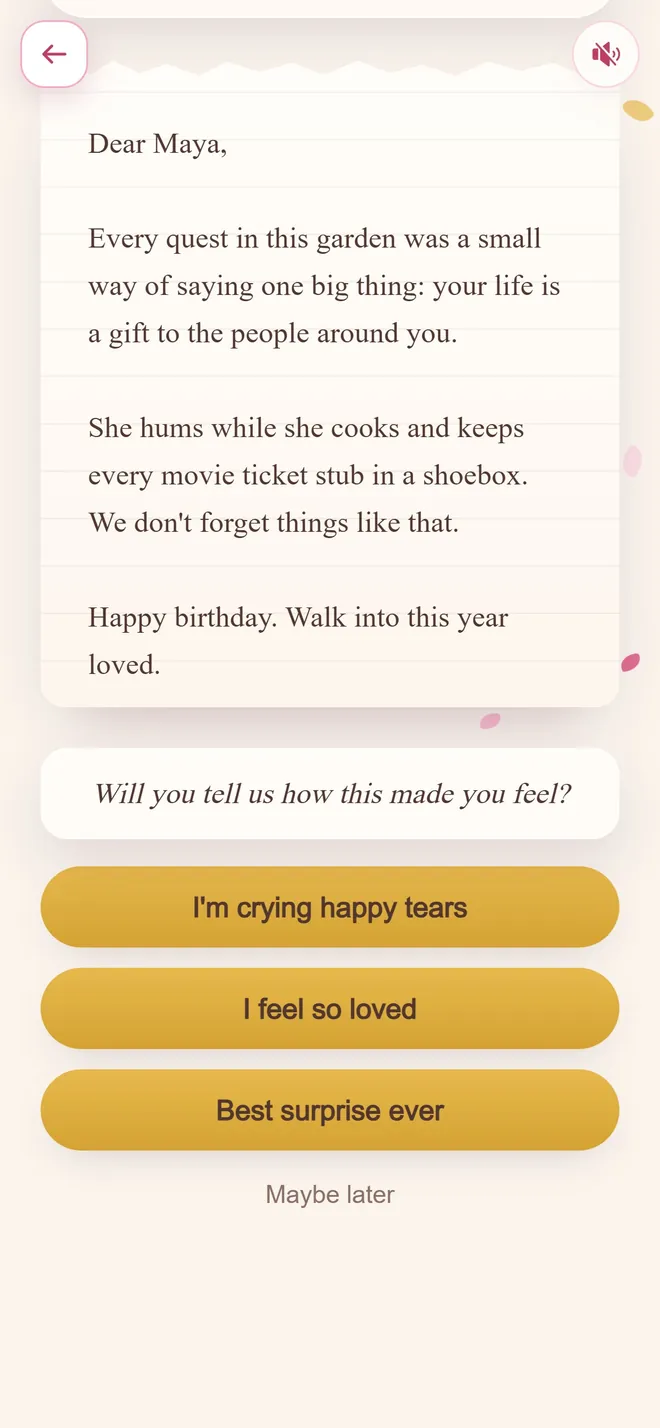
One last letter
the finale
Why interactive formats help here
A single dense paragraph forces every sentimental beat to compete for attention at once. Spreading the same content across several paced scenes, the way an interactive quest does, gives each detail room to land on its own rather than blurring into the one before it.
It also makes editing easier: a weak line is easy to spot and cut when it has its own screen, harder to notice buried in the middle of a paragraph.
Sentimental gifts across different occasions
The same principles hold whether the occasion is a birthday, an anniversary, or a thank-you with no fixed date at all, but the ratio shifts. A birthday can carry a full arc of memories; a spontaneous thank-you usually lands best as one tightly specific moment rather than an attempt at a whole retrospective.
Match the scope of the gift to the size of the occasion. An anniversary can hold a decade's worth of detail. A gift with no occasion attached, sent simply because you were thinking of someone, works better small.
Rereading it a week later
A useful final check: set the draft aside for a day, then read it again with fresh eyes before sending. Lines that felt sincere while you were deep in the memory sometimes read as overwrought once the immediate emotion has settled, and that gap is much easier to see with distance than in the moment of writing.
What to do when you cannot find the right words
Sometimes the block is not a lack of feeling but a lack of a clear starting sentence. In that case, skip the opening entirely and start from the middle: write the single most specific memory you can think of, in plain language, with no attempt at a polished first line. The rest of the piece tends to follow more easily once one true, concrete detail is already on the page.
The ideas, in order
- 1
A specific detail memory scene
Concrete specifics keep sentiment from curdling into generic warmth. Name the exact thing, not the category of feeling.
- 2
An understated, plainly stated truth
One direct sentence, stripped of flourish, often lands harder than three paragraphs of ornate language.
- 3
A humor adjacent sincere moment
Placing a joke near the sincere line keeps the whole thing from tipping into greeting-card territory.
- 4
A reopenable keepsake format
A gift meant to be read again later needs less peak intensity and more durable, specific detail.
- 5
A collected evidence approach
Multiple small true details in sequence build sentiment more reliably than one attempt at a grand statement.
- 6
A before and after pairing
Show something as it was at the start of the relationship and again now. Change witnessed over time reads as sentiment without a single sentimental word.
Examples you can borrow
Not the version where I say you changed my life. The version where I remember exactly which Tuesday it was, because you brought soup to an apartment I had not told you the address of yet.
Naming the concrete detail first, and the abstract claim second (or not at all), is what keeps this from tipping into cheesy.
That is really all it is. I noticed, and I wanted you to know that I noticed.
A plain, short sentence at the end of a sentimental piece often lands harder than a bigger finish would.
I am not going to pretend this is not a bit much. It is a bit much. I have decided I do not care.
A moment of self-aware humor right before or after a sincere line keeps the whole thing readable rather than saccharine.
Mistakes worth avoiding
Reaching for grand, vague language
"Words cannot express" and similar phrases are the fastest route to cheesy. Specifics are the fix.
Overwriting a simple true feeling
Sometimes the plain sentence beats the elaborate one. Do not decorate a strong idea into a weak one.
Skipping any contrast or lightness
Unrelenting sentiment with no counterweight is what tips a gift into cheesy. A little levity helps it land.
Borrowing language instead of using your own
A quote or lyric can open a gift, but if it does the emotional heavy lifting instead of your own words, the gift reads as outsourced.
Related ideas
Common questions
What is a good sentimental gift?
One that proves attention: a memory based experience, a letter with real stories, or a keepsake tied to a shared moment. Match intensity to the relationship.
How do I keep a sentimental gift from feeling cheesy?
Use concrete details, your natural vocabulary, and fewer abstract claims. Specific always sounds more adult than glittery generalities.
Is it possible to be too sentimental?
Yes, when the sentiment outruns the specificity behind it. A gift with strong feeling and thin detail reads as performative. Keep adding detail until the feeling has enough evidence to support it.
What if I am not naturally a sentimental writer?
Start from a single true memory rather than trying to write feelings directly. Describing what actually happened, in plain language, usually produces something more moving than reaching for emotional vocabulary.
Do sentimental gifts work for coworkers or new relationships?
In a lighter form, yes. Scale the intensity down and lean even harder on one specific, low-stakes detail rather than attempting the same depth you would bring to a decades-long relationship.
Build a personalized quest
Free to start. Pay only when you are ready to share.