
guide
What is a collaborative digital gift?
A collaborative digital gift is a private present for one recipient. Friends or family add memories, notes, and photos in private drafts; one organizer reviews those additions and publishes one paced gift the recipient opens as a link, with no app required.
A collaborative digital gift is a private present made for one recipient by a small circle of people, then shaped by one organizer into a single experience they can open as a link.
Updated
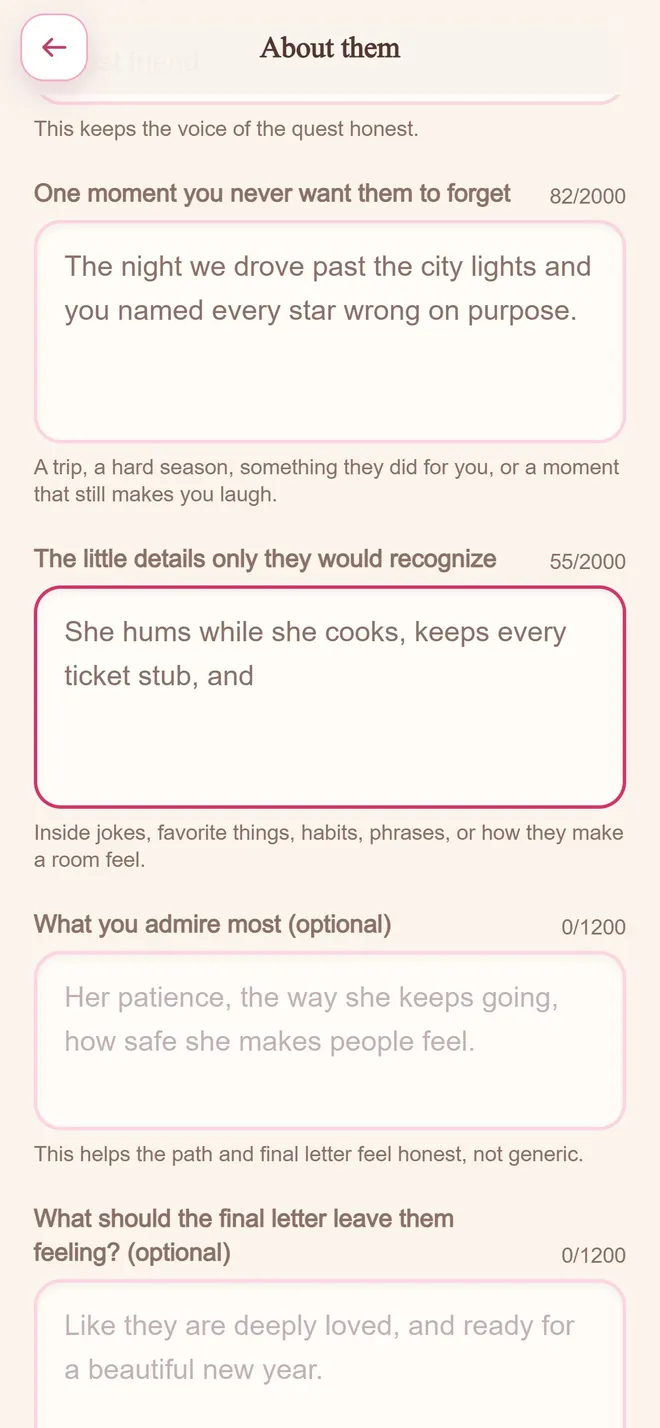

The memories only you know
step 02 · the brief
A collaborative digital gift, defined
A collaborative digital gift is a present that several people help make, and that one person receives. That sounds obvious until you look at what most group gifts actually are: a shared board, a signed card, or a pile of texts that never get collected. Those formats gather volume. A collaborative digital gift gathers material, then turns it into one experience.
The difference is authorship after the collecting. Someone still holds the shape. They decide what belongs, in what order, and how the recipient will move through it. Contributors do not pin a note onto a wall the rest of the group can already read. They offer a memory, a photo, a blessing, or a short letter, and they wait for the organizer to place it.
That is why a collaborative digital gift can feel intimate even when it has more than one voice. The recipient is not scrolling a gallery of coworkers. They are walking a path that was made for them, with names attached to the moments that belong to those people. The gift still has a beginning, a middle, and a landing. It still sounds like care rather than a roll call.
BloomQuest: Celebrate builds this as a collaborative quest: one organizer, one recipient, optional private invites, and a review step before anything is published. You can still make a quest alone. Collaboration is the option for the days when the right gift is not only from you.
Why people look for a collaborative digital gift
Most people arrive at a collaborative digital gift after a smaller gift has already failed them. A sibling birthday where four of you each sent a separate text. A graduation where the family group chat filled with photos that the graduate will never find again. A long-distance friend whose people are spread across three cities and cannot sign the same paper card.
The instinct in those moments is to collect. Collecting is useful. It is also incomplete. If you stop at collecting, the recipient gets a stack: twenty short notes, a folder of images, a video they have to sit through in one take. A collaborative digital gift finishes the job. It takes the same raw material and gives it pacing, order, and a private place to return to.
There is also a privacy reason. Plenty of what a sister would write, or a best friend would send, should not live on a board that fifteen other people can open. A collaborative digital gift keeps drafts hidden from other contributors until the organizer accepts them. The recipient still sees who wrote what. The group does not get to read each other's unreviewed work.
Distance is the other common reason. Physical group gifts stall on shipping, signatures, and who still has the card. A collaborative digital gift can be assembled from different timezones and opened on the morning that actually matters. The recipient does not install anything. They open one link.
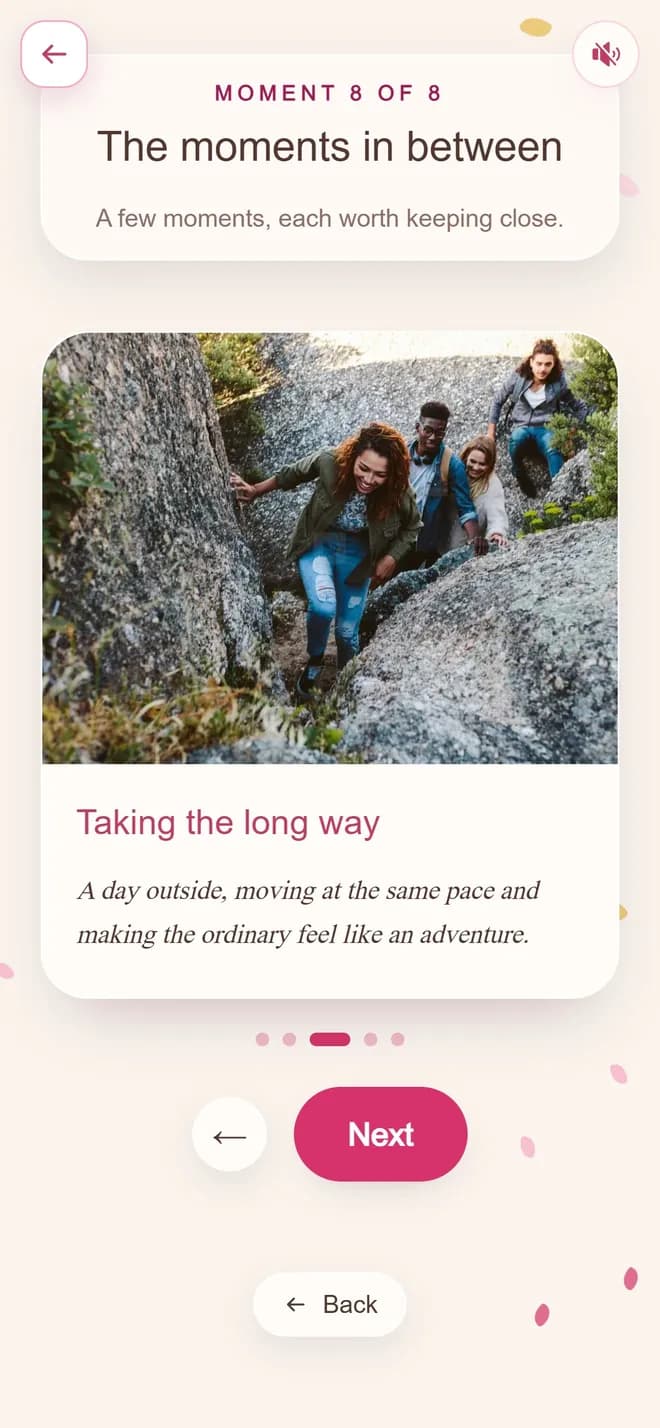
The moments in between
moment 8 of 8 · your photos
A collaborative digital gift is not a group card
Group cards and group boards are good at a different job. They show that a lot of people noticed. Every signer can usually read every other signer, which quietly caps how personal any one line can be. People write the warm, interchangeable sentence they would be willing to put in front of the rest of the office.
A collaborative digital gift does the opposite. Contributors write for the recipient, not for the audience of other contributors. The organizer can cut a line that is too generic, keep a memory that would have felt too private on a board, and put the strongest piece last so it lands. The recipient still sees names. They do not have to wade through a wall to find the one note that was actually about them.
If twenty coworkers need to sign something, use a group board. If a small circle has real history with the person, a collaborative digital gift is the better shape. The two can sit on the same day: the board for the wider group, the collaborative digital gift for the people who should not be writing in public.
The mix-up happens because both formats involve more than one author. Authorship is not the test. The test is what the recipient opens. A board is a collection. A collaborative digital gift is a path.
Who a collaborative digital gift is actually for
It fits siblings making a birthday for a parent. It fits a partner who wants a couple of close friends to add memories the recipient will recognize. It fits a graduation where parents, a sibling, and a mentor each have one thing to say, and none of those things belong on the same public card. It fits a long-distance family that cannot be in one kitchen to pass a card around.
The common pattern is a small circle and a specific person. Five people who actually know the recipient will make a stronger collaborative digital gift than fifty people who know them as a colleague. The format rewards density, not headcount.
It also fits the organizer who is already going to do the work. Someone has to start the world, send the invite, and review what comes back. If nobody wants that job, a group board is easier, because the board does not need a final edit. A collaborative digital gift assumes someone cares enough to hold the shape.
Recipients who dislike public attention are a particularly good match. They can open a collaborative digital gift alone, on a phone, without performing gratitude in a thread. That privacy is part of the present, not a setting you turn on later.
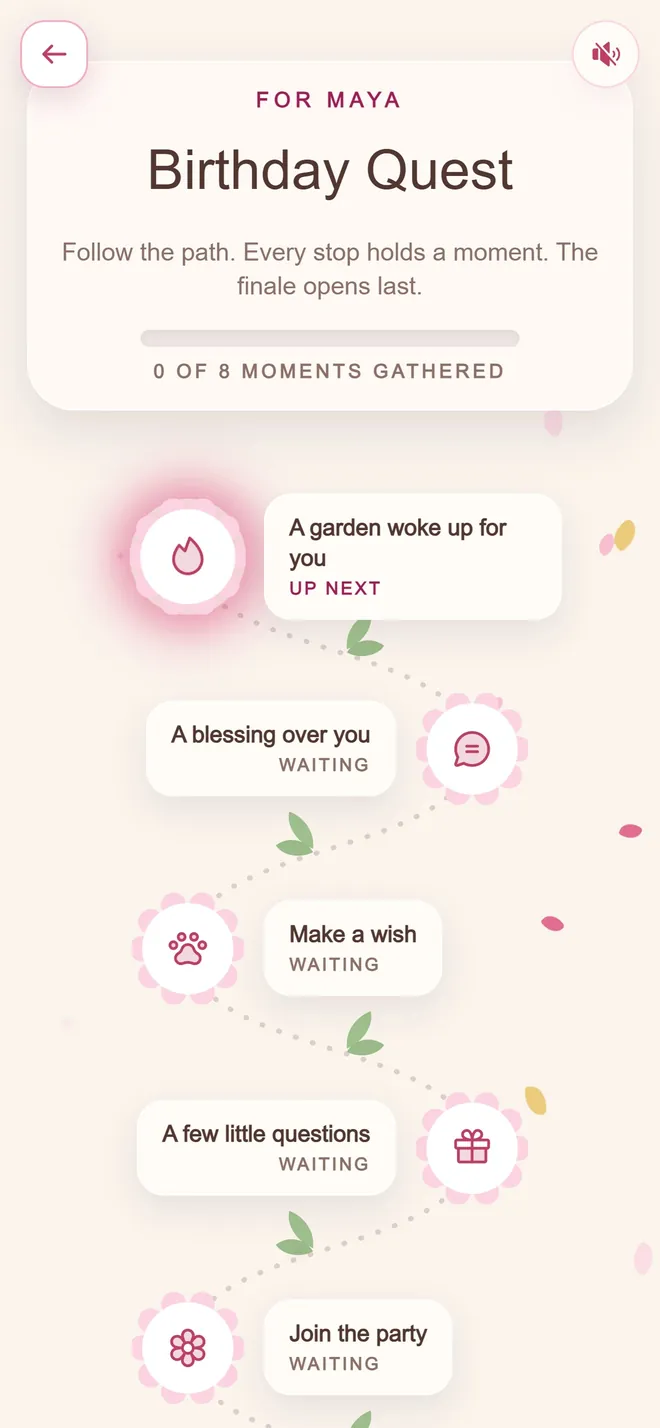
Every stop holds a moment
the path they walk
When you should not make a collaborative digital gift
Skip it when the point is volume. A farewell for a whole department, a classroom thank-you, or a retirement where the signal is how many people signed: those occasions want a board. Forcing them into a reviewed quest makes extra work and still will not look like a crowd.
Skip it when you cannot review. If you invite people and then publish whatever arrives, you have built a less convenient group card. The review step is not optional flavor. It is the difference between a collaborative digital gift and a dump of files.
Skip it when the recipient is in the invite thread. A collaboration link is unlisted, not invisible to anyone who holds it. Share it only with contributors. Never drop it in a chat that includes the person the gift is for.
Skip it when you needed money collected. A collaborative digital gift is not a pooled purchase. If the group is chipping in for a physical present, use a tool built for that, and make the collaborative digital gift the personal layer beside it if you still want one.
What contributors add to a collaborative digital gift
The useful contributions are small and specific. A memory only that person would have. A photograph with a sentence under it. A blessing that names a quality. A wish for the year ahead that is not a slogan. A finale note the organizer can place at the end. Those are the raw materials of a collaborative digital gift.
Generic wishes are the waste product. "You are amazing" from six people is still one sentence. Ask for one scene: the afternoon they drove you home, the joke that still works, the thing they did when nobody was watching. If a contributor cannot name a scene, they may not belong in this gift. That is allowed. A collaborative digital gift is allowed to be exclusive in a way a team card is not.
Photos need a caption. An unlabeled image in a collaborative digital gift is decoration. A caption that says when it was, who was there, and why it still matters turns the image into a station on the path. In BloomQuest: Celebrate, accepted photos credit the contributor by the display name they chose, and collaboration galleries can open from one tile per person into that person's set.
Contributors work in their own drafts. They do not edit the live quest. They do not see other people's unreviewed material. That constraint is what lets someone write a sentence they would never put on a board. The organizer is the only person who sees the full pile before the recipient does.
The organizer's job in a collaborative digital gift
The organizer starts the world, chooses the occasion, and writes the first draft. Collaboration does not replace that. A collaborative digital gift with no spine is just a folder. BloomQuest: Celebrate still generates a quest from the organizer's brief so there is a path to place contributions into.
Then the organizer invites. The invite should say who the gift is for, what you want, and that you will review it. A vague "add something nice" produces niceness. A specific ask produces a collaborative digital gift: one memory, one photo, one sentence they have never said out loud.
Review is the real work. Accept, edit, reorder, or decline. Change a flower, or choose none. Put the quiet piece after the funny one. Hold the strongest letter for the end. If two people wrote the same story, keep the better telling. The recipient will not know what you cut, and that is the point of having an organizer.
Publishing closes the invitation. The live gift does not change until you review a later cycle and publish again. Preview the whole path after you finalize contributions, the same way you would after editing your own scenes. A collaborative digital gift that has not been walked through is still a draft.
How to make a collaborative digital gift that people actually finish
Start with the recipient, not the guest list. Name the occasion, the feeling you want at the end, and two or three people who have real material. Invite that circle. Resist the urge to add everyone who might feel left out. A collaborative digital gift gets weaker as the circle gets polite.
Give contributors a deadline that is earlier than you think. Review takes time. So does asking someone to rewrite a generic line. Build, invite, wait, review, preview, then publish. Same-day versions work only when the circle is tiny and already knows what they want to say.
Write the invite in the same tone as the gift. If this is a quiet family birthday, do not send a rallying email that sounds like a team offsite. Tell them the recipient will see their name. Tell them other contributors will not see their draft. Tell them one specific memory is enough.
When the pieces are in, read the whole collaborative digital gift aloud. Anything you stumble over is still written in someone else's register, or in the generated draft's register. Cut it or rewrite it. Then schedule the unlock for their morning if the day is date-sensitive, and send the private link through the channel you already use with them.
Occasions that hold a collaborative digital gift well
Birthdays are the default, and they are a good default. A collaborative digital gift for a birthday can carry siblings, parents, and a best friend without turning into a roast. The birthday quest in BloomQuest: Celebrate already has a garden path; attributed cards and photos sit inside that path rather than replacing it.
Graduations, farewells inside a family, and friendship anniversaries are almost as natural. Those days already have more than one witness. The mistake is stuffing every witness into the gift. Pick the two or three who were actually there for the years you want to name.
Mother's Day and Father's Day work when the children are the contributors and one of them organizes. A collaborative digital gift from siblings can say the things a single card from "all of us" usually flattens. Each accepted piece still has a name on it.
Be careful with proposals and private letters. You can invite a tiny circle, but the more people who hold the collaboration link, the more ways the surprise leaks. For a sealed question, solo is often the honest choice. A collaborative digital gift is optional on every occasion world; it is not required.
Privacy, delivery, and what the recipient has to do
A published collaborative digital gift lives at one unlisted link with a hidden key. It is not listed for search, and it is not a public gallery. Anyone who has the link can open it, so treat it like a letter. Send it to the recipient. Do not post it.
Collaboration invites are a separate kind of unlisted link. They are for contributors, not for the recipient, and not for search engines. Publishing closes that invite. If you need another round later, you start a fresh invite, review it, and republish. The live gift stays what you last published until then.
The recipient does not need BloomQuest: Celebrate, an account, or a new app. They open the link in a browser on a phone or a computer. That is the delivery model for every quest, collaborative or solo. Mention it when you send the link so they do not stall looking for a download.
What gets recorded on their side is small: that they opened it, how far they got, and any answer they chose or wrote. No name, no email. Contributor display names are the names those people chose for the gift, not a public identity graph.
How BloomQuest: Celebrate makes a collaborative digital gift
You pick an occasion world and choose Start a Collaboration Quest rather than Start a Solo Quest, then generate the first draft from the memories you already have. That draft is the spine, and it needs to exist before you invite anyone, because contributions are placed inside your moments rather than appended to the end. Open Make it together, set an optional deadline, and you get an unlisted invite link and a QR code to send.
Contributors do not fill in a form. They sign in, choose the display name that will appear on their pieces, and then walk the quest you built, adding a memory, story, wish, blessing, inside joke, photo, or finale note inside the moment where it belongs. Every moment including the finale is open to them straight away, because they are authoring rather than playing. One person can leave up to five cards in a moment and up to seven photos across the quest.
You review every item before it becomes part of the world, with each contributor in their own tab and anything waiting on you marked. You approve a card or a whole collection, send a piece back with a note, order what you keep, and change how an accepted card is decorated. After approving you can preview that exact moment as the recipient will meet it. If someone should no longer have access you revoke them, and if the link reaches the wrong person you rotate it. Contributors never pay. One-time worlds include up to five collaborators; Celebration Year includes up to thirty per world. Building, editing, and previewing stay free; you pay when you publish the shareable link.
The published collaborative digital gift is still one quest for one recipient. Older installed players that cannot show a full collaboration gallery still get a safe reduced photo list. The words and the path remain readable. That is deliberate: a gift should not break because someone's phone is on an older version of the app.
If you want the product view of the same capability, the collaborative quests feature page is the shorter map of invites, review, and limits. This guide is the longer answer to what a collaborative digital gift is, when to make one, and how to run it without turning it back into a board.
Collaborative digital gift ideas that stay specific
- 1
A sibling birthday for a parent
One child organizes the collaborative digital gift; the others add one memory each, reviewed into a single path.
- 2
A graduation from the inner circle
Parents, a sibling, and one mentor each contribute a named note the graduate opens as one quest.
- 3
A long-distance family birthday
People in different timezones add drafts; you review and schedule the collaborative digital gift for their morning.
- 4
A friendship anniversary from the two or three who were there
Keep the circle tiny so the collaborative digital gift stays a path, not a reunion wall.
- 5
A Mother's Day from the children
Each kid adds a specific scene; the organizer puts the quietest one last.
- 6
A thank-you from a small team who actually worked together
Three named memories beat fifteen generic signatures on a board.
How to make a collaborative digital gift
- 1
Choose the recipient and the occasion
A collaborative digital gift starts with one person and one day. Pick the world that matches the feeling, not the largest possible guest list.
- 2
Write the first draft yourself
Generate and edit a spine from your own memories so contributions have somewhere to live. Collaboration is an addition, not a substitute for a first draft.
- 3
Invite a small circle with a specific ask
Send a private invite. Tell them the gift is for one recipient, that you will review what they add, and that one concrete memory is enough.
- 4
Review, order, and cut
Accept, edit, or decline each piece. Put the strongest moment where it will land. A collaborative digital gift is made in this pass, not in the invite.
- 5
Preview, then publish one private link
Walk the path as they will. Publish when it feels like one gift. Send the unlisted link to the recipient, not to the group chat that includes them.
Lines you can send or keep
I am making a private birthday world for Maya. If you have one memory or photo you want in it, add it here. I will review everything before she sees it, and the other people I invited will not see your draft.
Names the recipient, the review step, and the privacy between contributors.
Write the one thing you would want her to hear from you, not a toast the whole table already heard. One scene is enough.
Blocks the generic wish before it is written.
This is from a few of us. Each piece is signed. I chose the order. Open it when you have ten quiet minutes; you do not need an app.
Sets expectation without spoiling the path.
The night you waited in the car so I would not have to walk from the station alone. You had work in the morning. I still think about that more than the big birthdays.
A scene, a cost, and a reason it stayed. That is the unit of this format.
How the options compare
A collaborative digital gift versus the formats people confuse it with.
| Group card or board | Video montage | Collaborative digital gift | |
|---|---|---|---|
| Who it is for | Often a crowd | A crowd, as faces and voices | One recipient |
| How people add | Pin on a shared wall | Send clips to an editor | Submit a private draft |
| Who decides | Whoever has the board link | The editor of the film | The organizer reviews every item |
| What they open | A gallery of posts | One video to watch | One paced quest with named moments |
| Privacy between contributors | Usually everyone can read everyone | Clips may be seen in the final cut only | Unreviewed drafts stay hidden |
| Recipient effort | Scroll | Sit through a film | Walk a short path in a browser |
Mistakes worth avoiding
Inviting a crowd because it feels inclusive
A collaborative digital gift gets thinner as the circle gets polite. Invite the people with material, not the people who might be offended.
Publishing without reviewing
If you accept everything unedited, you have built a group card with extra steps. The review pass is the gift.
Asking for "a message"
That prompt produces slogans. Ask for one memory, one photo with a caption, or one sentence they have not already said.
Putting the recipient on the invite
The collaboration link is for contributors. A collaborative digital gift that the recipient can enter early is no longer a surprise.
Treating it as a replacement for a team board
If the job is fifty signatures everyone can read, use a board. A collaborative digital gift is the private path beside that board, not a substitute for it.
Related ideas
How it works in the app
Common questions
What is a collaborative digital gift?
A collaborative digital gift is a private present for one recipient, made with memories, notes, and photos that friends or family add and an organizer reviews, then published as one link they open in a browser.
How do you make a collaborative digital gift?
Choose one recipient, draft the gift, privately invite a small circle, review every contribution, preview the path, and publish one unlisted link. BloomQuest: Celebrate is built for that sequence as a collaborative quest.
Is a collaborative digital gift the same as a group card?
No. A group card is a wall of independent posts the whole group can usually read. A collaborative digital gift is one paced experience: contributors submit privately, the organizer reviews, and the recipient walks a single path.
Who should organize a collaborative digital gift?
Whoever is closest to the recipient and willing to review. The organizer starts the world, sends the invite, decides what is included, and publishes. Contributors do not edit the live gift.
Can family members contribute to a collaborative digital gift?
Yes. That is one of the strongest uses: siblings, parents, or a partner adding reviewed memories into one present. Keep the circle small enough that every piece is specific.
Does the recipient need an app for a collaborative digital gift?
No. In BloomQuest: Celebrate they open one private link in any web browser. Only the people building the gift need the app.
How many people can help with a collaborative digital gift in BloomQuest: Celebrate?
One-time worlds include up to five collaborators. Celebration Year includes up to thirty per world. Contributors never pay. For a public signing wall of dozens, a group board is still the better tool.
What should I ask people to write for a collaborative digital gift?
Ask for one concrete memory, one captioned photo, or one sentence they have not already said in a group chat. Specific scenes are what make a collaborative digital gift worth opening.
Build a personalized quest
Free to start. Pay only when you are ready to share.