
guide
AI gift ideas that still feel human (because you stay the author)
AI gifts feel human when the input is true, the edit pass is honest, and the final voice is yours. Skip one-click poems you never read.
Updated
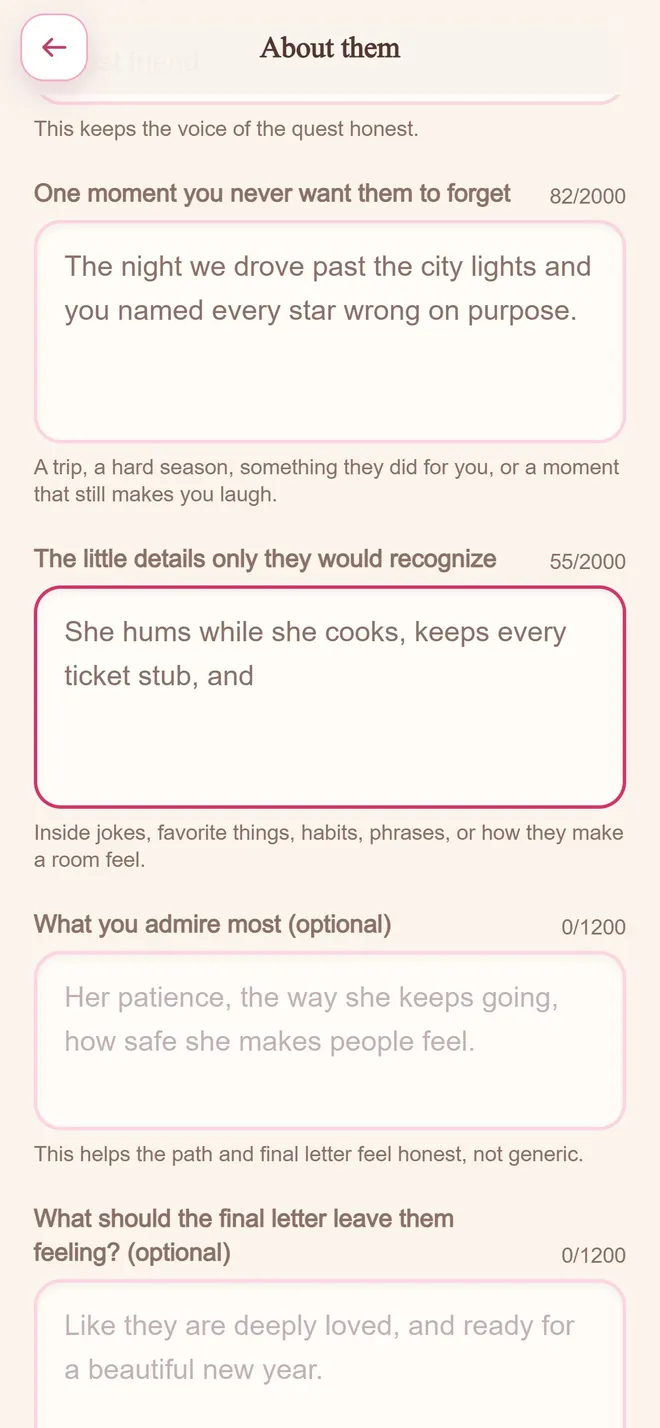

The memories only you know
step 02 · the brief
Treat AI as a first draft partner
Provide specific memories and relationship context. Refuse outputs that sound like every other card in the store.
BloomQuest: Celebrate is built around that loop: generate from your brief, then fully edit before anyone else sees the quest.
Prefer interactive structure over a single poem
A paced quest with scenes and a finale often feels more intentional than a block of unedited generated verse. Structure signals care.
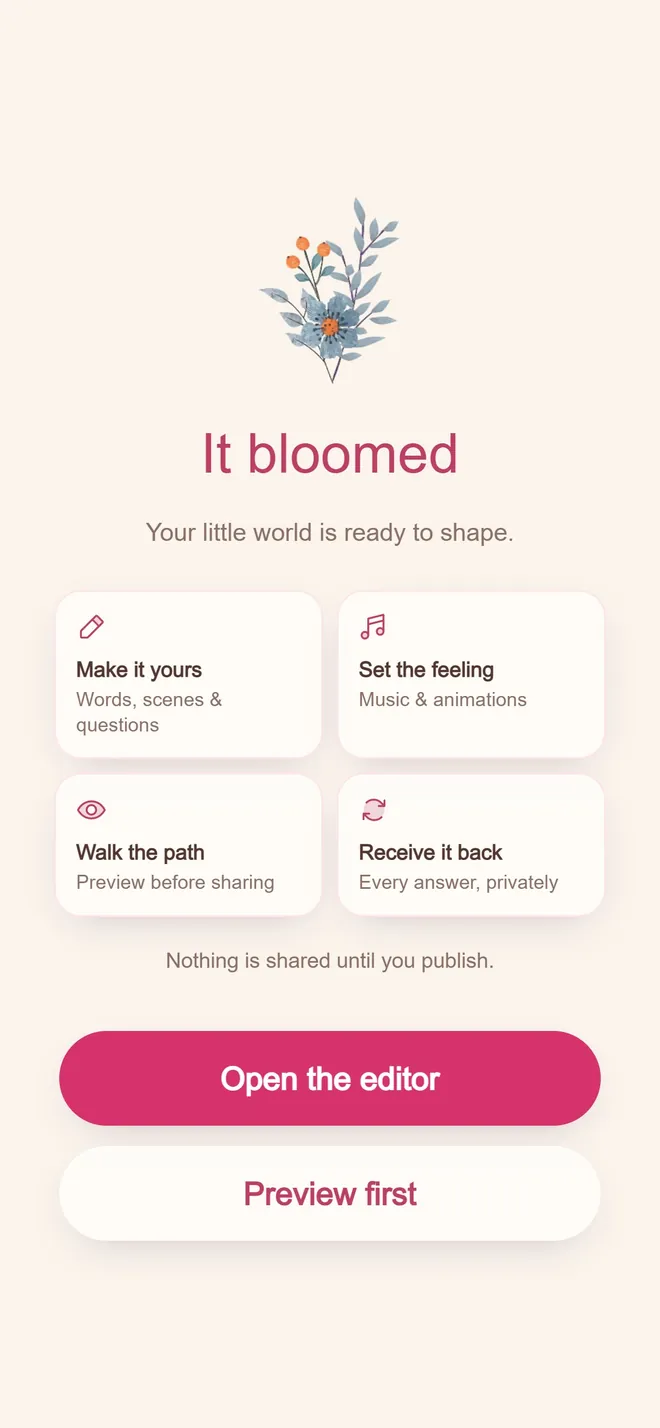
It bloomed
step 03 · under a minute
Privacy and control
Know how a product uses your content. BloomQuest: Celebrate does not use creator words or recipient replies to train AI models, and you decide what publishes.
How to tell if a draft still needs work
A quick test: could this exact paragraph be sent to three different people without anyone noticing it was reused? If yes, it needs another pass. Generated text tends to gravitate toward phrasing that is technically warm but structurally interchangeable, and that gravitational pull is exactly what an edit needs to counteract.
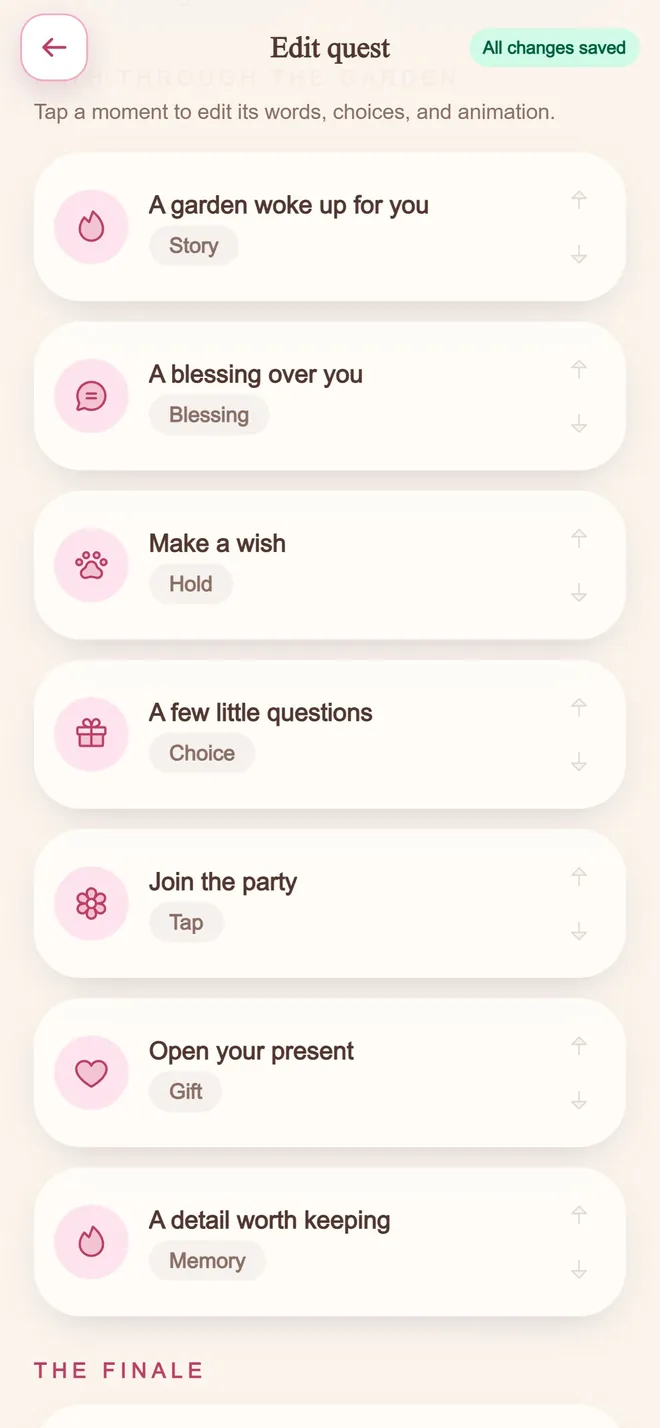
Rewrite any line
step 03 · the editor
Where AI genuinely helps most
Structure and pacing are where generation tools add the most real value: turning a loose set of memories into an ordered sequence of scenes is tedious to do from scratch and fast for a tool to draft. Save your own effort for the sentences that carry the actual emotional weight, and let the tool handle the scaffolding around them.
How to do it, step by step
- 1
Use AI to skip the blank page, not to finish the job
Generation should produce a starting structure. Treat the first draft as raw material, not a finished gift.
- 2
Feed it real, specific memories
Generic prompts produce generic output. The more specific the input, the more usable the draft.
- 3
Edit ruthlessly
Rewrite any line that could apply to someone else. This is the single step that most separates human-feeling gifts from generic ones.
- 4
Write the finale yourself
Whatever the most emotionally important line is, treat it as yours to write, not the generator's.
- 5
Choose an interactive format over a stock poem
AI generated poems are common and recognizable. A structured personal quest uses AI differently and reads as more intentional.
- 6
Read the whole draft aloud before publishing
Generated text can read fine silently and sound noticeably off once spoken. This catches most of what a silent read misses.
Examples you can borrow
Happy birthday to an amazing friend! You bring so much joy and light into my life. Wishing you all the best on your special day!
Grammatically fine, entirely interchangeable between recipients. This is the output an edit pass needs to replace, not polish.
Happy birthday to the person who once drove forty minutes to bring me soup and refused to let me thank her for it properly. I am still trying.
Same warmth, but now unmistakably about one specific person and one specific act.
Mistakes worth avoiding
Publishing the first generated draft
The most common way an AI gift ends up feeling impersonal. The draft is a beginning, not an ending.
Feeding it vague prompts
"Write something nice for my friend's birthday" produces exactly the generic output people are afraid of. Specificity in, specificity out.
Avoiding AI entirely out of caution
The tool is not the problem; skipping the edit is. Used well, it removes the hardest part of starting.
Letting the tool write the finale
The single most emotionally important line in the gift should be the one place the generator's voice is completely absent.
Related ideas
Common questions
Can an AI gift feel personal?
Yes if it is grounded in your real details and you edit until it sounds like you. Unedited generic output rarely feels personal.
What AI gift should I avoid?
One-click poems or images with no relationship input and no review step. They save time by erasing you from the gift.
How do I know if a generated draft is good enough to send?
Check whether the specific lines could apply to someone else unchanged. If any could, rewrite them with a detail unique to the actual recipient before publishing.
Should I write the whole gift myself instead of using AI at all?
Not necessarily. Using AI for structure and a first pass is fine as long as you edit the specific, emotionally important content yourself rather than publishing it unchanged.
Build a personalized quest
Free to start. Pay only when you are ready to share.