
guide
How to write a thank-you message that actually lands
Most thank-you messages fail for the same reason: they describe a feeling instead of an action. This guide breaks down the structure that makes gratitude specific enough to land.
Updated
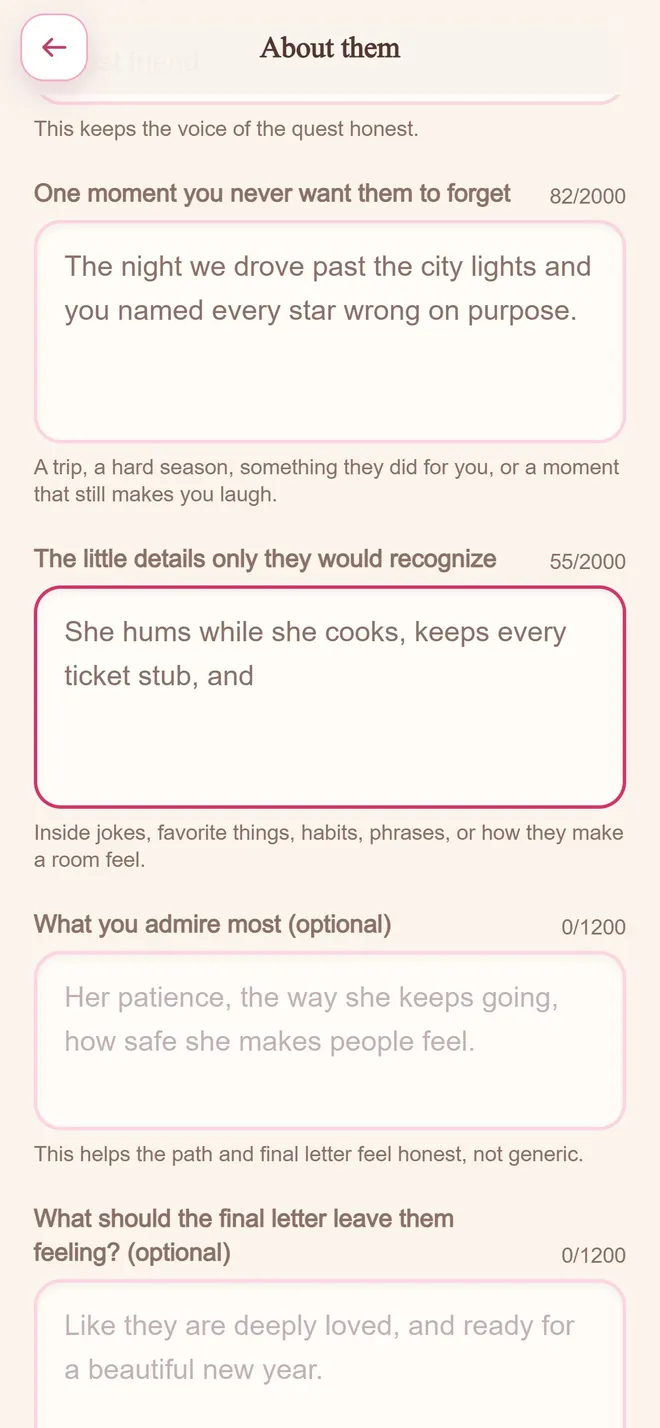

The memories only you know
step 02 · the brief
Start with the moment, not the feeling
"Thank you for everything" is not a sentence anyone can picture. A specific Tuesday, a specific phone call, a specific favor is. The moment is what gives the recipient something to actually recognize as theirs, rather than a compliment that could be sent to a dozen other people unchanged.
This is the single hardest habit to build and the one with the highest return. Before writing anything else, find the one memory that could only be about this person, and open with it.
Separate what they did from what it changed
The action is the easy half to write: what they did, when, how. The effect is the harder, more valuable half: what actually shifted in your life because of it. A decision you made differently. A version of yourself that only exists because they showed up.
Most thank-you messages stop at the action. Adding one plain sentence about the effect is usually the single edit that turns a nice note into a message someone keeps.
It bloomed
step 03 · under a minute
When to send it, and when not to wait
A retirement, a farewell, or a milestone is a fine occasion for gratitude, but it is not the only valid one, and it should not be the only trigger. The version sent on an ordinary week, for no reason at all, tends to land harder, because nothing obliged you to write it.
If the relationship is a teacher, boss, mentor, or caregiver rather than a close friend, the same structure still works. It does not require shared history the way a friendship message does, only a specific moment and its effect.
The ideas, in order
- 1
Start with the moment, not the summary
"You always helped me" is a pattern. The Tuesday they rearranged their afternoon for you is a person. Open on the moment.
- 2
Separate the action from its effect
What they did is the easy half to write. State plainly what it changed for you, which is the half that actually lands.
- 3
Add the smaller, cumulative evidence
Not every quality needs its own paragraph. A short list of smaller things builds weight without needing a fresh story each time.
- 4
Name the version without them, briefly
One sentence on what would be missing without them makes the gratitude concrete, without turning into an overwrought detour.
- 5
Keep the closing line plain
After specific evidence, the ending does not need decoration. One direct sentence about what stayed with you outperforms a paragraph reaching for the right words.
- 6
Send it without waiting for a reason
A thank-you attached to a goodbye can read as obligation. The same words sent for no reason read as intention.
Mistakes worth avoiding
Using adjectives instead of evidence
"You are amazing" describes your opinion. The moment that formed that opinion is what the recipient can actually recognize as true.
Writing something reusable for anyone in that role
If the message would work unchanged for a different teacher, boss, or friend, it is missing the one detail that makes it theirs.
Making it about your own growth
Reflection on how you changed is real, but keep the camera pointed at what they did. Their action is the gift's subject, not your arc.
Related ideas
Related occasions
Common questions
What is the best structure for a thank-you message?
Open on one specific moment, state what it changed for you, add a little supporting evidence, and close on one plain sentence. Specificity matters more than length or polish.
Should a thank-you message be funny or sincere?
Whichever tone you actually use with this person. A message that suddenly turns formal or poetic for someone you have always joked with will read as a costume rather than gratitude.
Build a personalized quest
Free to start. Pay only when you are ready to share.