
how-to
How to write a personal birthday message that does not sound like everyone else's
A personal birthday message is a few true sentences about one person. Structure helps, but honesty and detail do the real work.
Updated
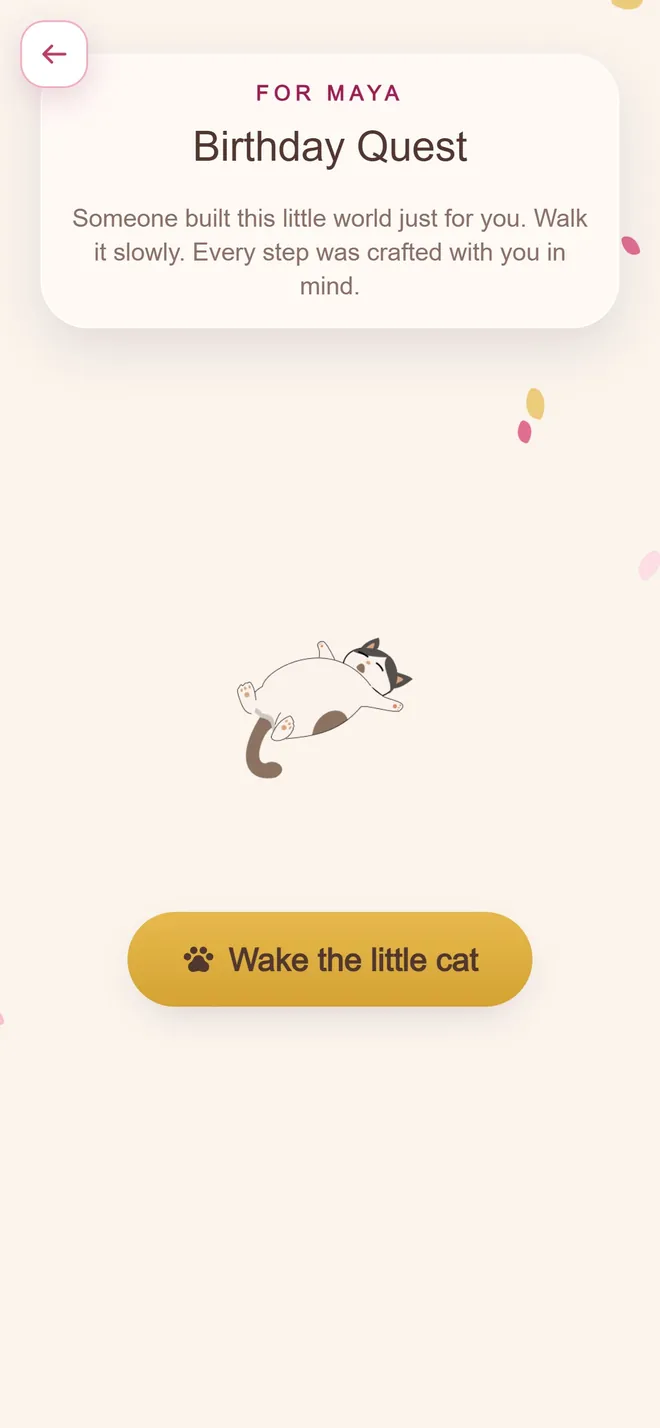
Wake the little cat
how a birthday quest opens
Ban sentences anyone could copy
"You're amazing" and "Have a great year" are fine as garnish, not the meal. Add one memory, one quality with evidence, and one hope for the next year.
Use a simple skeleton
Open with why this birthday matters, name two or three concrete moments, thank them for a specific habit, close with a wish that fits their actual life. Short paragraphs beat one dense block on a phone.
If you want the message to become an experience, drop those same ingredients into BloomQuest: Celebrate's birthday prompts and edit the draft until it sounds like you.
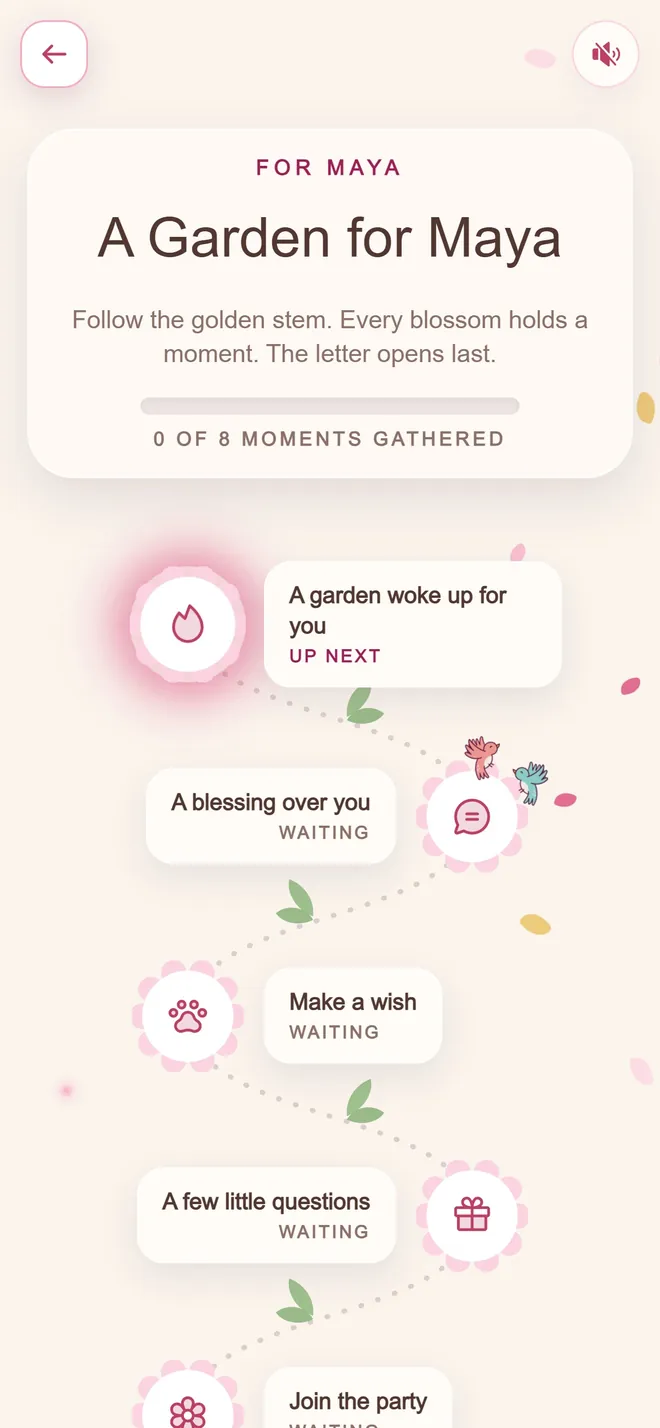
A Garden for Maya
birthday · garden quest path
Edit out the AI polish if you used help
Any drafting tool, including BloomQuest: Celebrate, should leave you with lines you would say out loud. Cut anything that feels like a greeting-card aisle.
Writing for someone you do not know well
A colleague or acquaintance's birthday message does not need the same specificity as a close friend's, but it still benefits from one true detail: something they mentioned recently, a project they finished, a small kindness you noticed. One real sentence beats three generic ones even at low intimacy.
Keep these shorter than a close-relationship message. Overreaching for warmth with someone you do not know well can read as performative rather than kind.
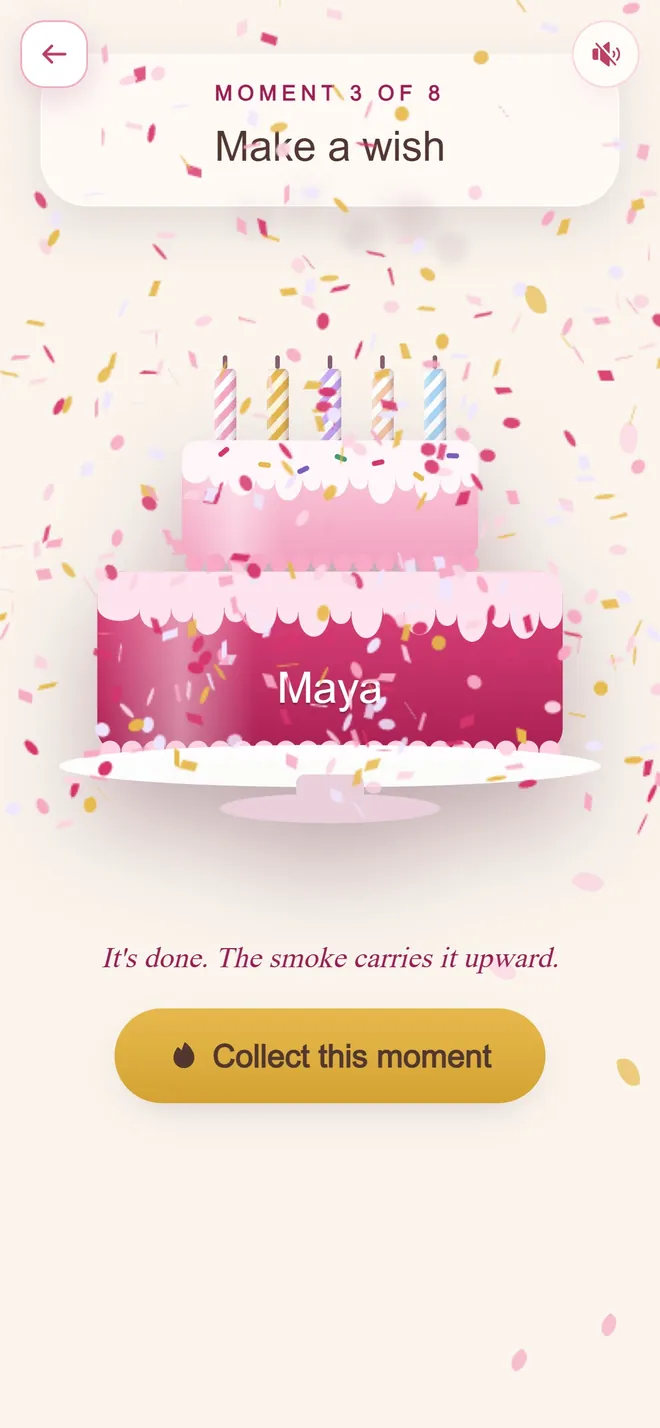
Make a wish
moment 3 of 8 · press and hold
Turning a message into something bigger
If the message keeps growing past what fits comfortably in a text, that is usually a sign it wants to be a small sequence of moments rather than one paragraph. Splitting a memory, a trait, and a wish into three short scenes the structure a birthday quest already uses often reads better than the same content compressed into a single dense block.
Writing across languages and cultures
Direct translation of an emotional register that works in one language does not always land the same way in another; some cultures favor understatement in written messages, others favor more overt warmth. If you are writing across a language gap, err toward specific detail over emotional vocabulary concrete memories translate more reliably than abstract sentiment does.
When the message is for a group of friends to sign together
The same principles apply even when several people are contributing lines to one card or board: each person's line should still name a specific, individual memory rather than echoing whatever the person before them wrote. A card where every line reads "same, happy birthday!" loses the value of having multiple contributors in the first place.
A quick before and after
Generic: "Happy birthday! Hope your day is amazing! You deserve the best!" Specific: "Happy birthday to the only person who has ever successfully talked me out of a bad haircut. Hope today involves zero decisions you have to talk yourself out of." Same length, same warmth, but only one of them could only be sent to one person.
How to do it, step by step
- 1
Pick one specific memory
Not a general period of time. One scene, with enough detail that only they would recognize it.
- 2
Name one trait, with evidence
State a quality about them and immediately back it with the moment that proves it, rather than leaving it as an adjective.
- 3
Write the wish last
The forward-looking line lands better after the specific memory and trait have already done the emotional work.
- 4
Cut anything that would work for someone else
If a sentence could be sent to three different people unchanged, it is not doing its job here.
- 5
Read it aloud once before sending
The fastest way to catch a line that sounds like a stranger, or a greeting card, wrote it.
- 6
Match the length to the platform
A text message and a card insert can carry the same content at different lengths. Trim for the medium rather than writing one version and pasting it everywhere.
Examples you can borrow
Eleven years ago today you showed up to my birthday with the wrong cake on purpose because you knew I liked the backup flavor better. I still think about that.
Naming a concrete, slightly odd detail signals immediately that the message was written for one person, not adapted from a template.
You are the only person I know who will drop what they are doing to help and never once bring it up again afterward.
States the quality and proves it in the same sentence, which does more work than either half alone.
I hope this year gives you fewer 6am flights and more of the mornings where nothing is due.
Specific to their real circumstances rather than a generic "hope this year brings you happiness" line.
Mistakes worth avoiding
Opening with a generic exclamation
"Happy birthday!!!" as an opener wastes the first line on something that carries no information.
Stacking adjectives instead of evidence
"You're so kind, funny, smart" says less than one specific moment that demonstrates any one of those.
Making it too long without structure
Length is fine if it is paced. An unbroken wall of text loses the reader before the good part.
Using someone else's words as the centerpiece
A quote can open a message, but if it does the emotional work instead of your own sentence, the message reads as borrowed rather than personal.
Related occasions
Common questions
How do I make a birthday message more personal?
Replace abstract praise with concrete memories, name specific qualities with examples, and write a hope that matches their real next year.
How long should a birthday message be?
Long enough to include real detail, short enough they will finish it. A few strong paragraphs usually beat a novel.
What do I write if we are not that close?
One genuine, specific detail is enough something recent you noticed or appreciated. Keep it shorter than you would for a close friend, and resist the urge to manufacture warmth that is not really there.
Should I use an AI tool to help write it?
It can help you get past a blank page, but treat the output as a draft. Read it aloud and cut anything that does not sound like something you would actually say.
What is a good structure if I only have a minute to write it?
One memory, one trait with evidence, one wish, in that order. Even at minimal length, that structure produces something more personal than an unstructured paragraph written under the same time pressure.
Build a personalized quest
Free to start. Pay only when you are ready to share.