
Sympathy
What to write in a sympathy card: 15 gentle messages and how to sign it
In a sympathy card, say you are sorry, use the name of the person who died, and share one memory or quality you admired if you knew them. Add a specific offer of help, such as a meal on a set day, and close simply. Two to four sincere sentences are enough; you do not need to fix anything.
Updated
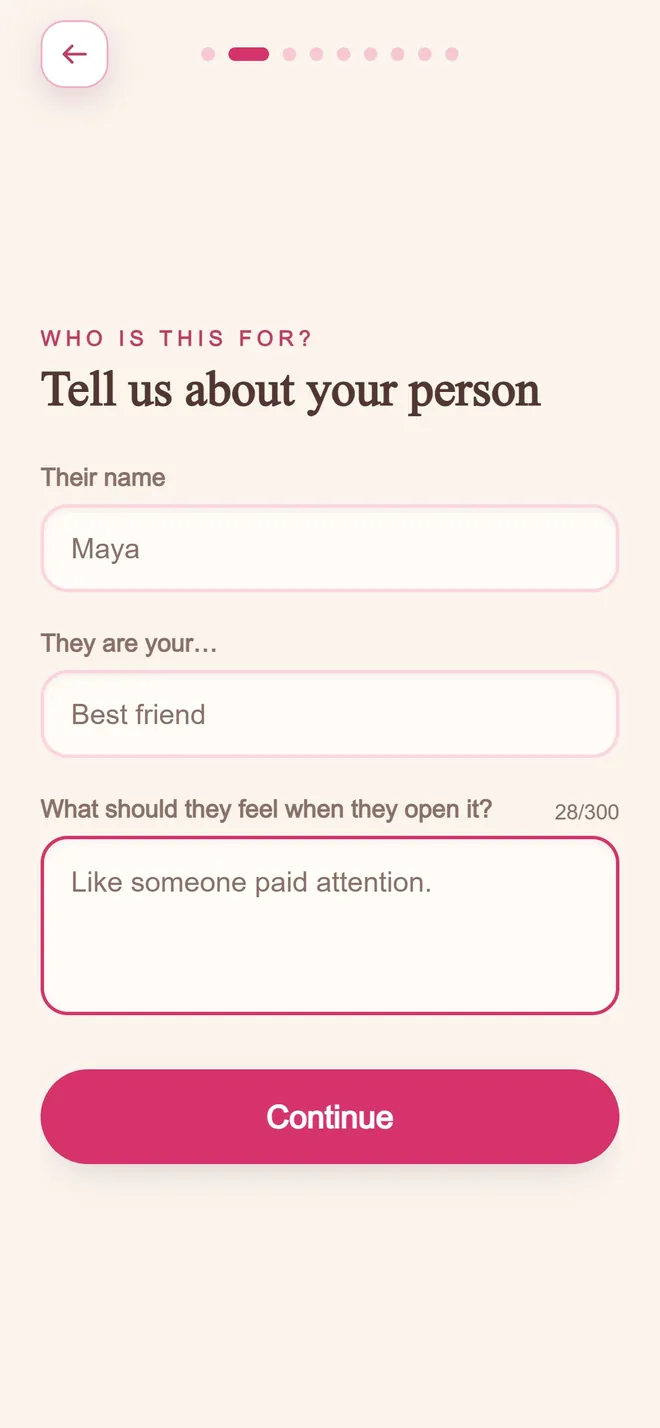

Tell us about your person
step 01 · who it is for
Writing a sympathy card is one of the hardest small tasks there is. You want to comfort someone in pain, you are afraid of saying the wrong thing, and the blank inside of the card seems enormous. Most people end up writing nothing at all, or a single line they feel unsure about.
The truth is that the grieving person will not judge your wording. What they remember is that you wrote, that you used their loved one's name, and that you did not ask them to feel better. The examples below are gentle, specific, and short enough to write in a few minutes.
A card is a constrained format: a fixed amount of space, read once in front of other people and then possibly kept for years. That constraint is what makes it hard.
A sympathy message cannot help, and trying to help is what makes most of them worse. Silver linings, reassurance about a better place, and instructions to be strong all ask the bereaved to manage the writer's discomfort.
15 sympathy messages
- With a memory
I am so sorry about Margaret. I will always remember her laugh at the garden club, the kind that made everyone else start laughing too. Thinking of you and holding you close.
- Simple
There are no right words, so I will just say that I am so sorry, and that I am here.
- Loss of a parent
Thinking of you and your family as you grieve your father. He was so proud of you, and it showed every time he spoke about you.
- With an offer
With deepest sympathy. I will drop dinner off on Thursday evening and leave it on the porch, no need to answer the door.
- Did not know them
I did not know your grandmother well, but I know how much she meant to you. I am holding you in my thoughts this week and in the weeks ahead.
- Traditional
I am so sorry for your loss. May the memories you shared bring you comfort, a little more each day.
- Coworker
Daniel was one of the most generous colleagues I have ever worked with. Our team will miss him deeply. Please accept our heartfelt condolences.
- Religious
Praying for you and your family. May God's peace surround you and give you rest in this hard season.
- Gentle
I have been thinking about you every day. No need to reply. Just know you are not alone in this.
- With their name
I am so sorry that Ruth is gone. The world is quieter without her, and I am grateful I got to know her.
- Friend
Sending love and strength to you all. Whenever you want to talk about him, I would love to listen.
- Neighbor
With sympathy and warm remembrance. Your mother was a light in our neighborhood, and we will miss her morning waves.
- Close friend
Words feel small right now, but my care for you is not. I am a phone call away, any hour.
- Long term support
Remembering Tom with you today, and in the months to come, when the cards stop arriving and the missing does not.
- Formal
Please accept my sincere condolences on the passing of your husband. I am keeping you in my thoughts.
What actually works in a sympathy message
The most common failure is spending the opening line on the occasion itself, which everyone can already see printed on the front of the card.
Use the person's name. Bereaved people report that others avoid it, and that the avoidance makes the loss lonelier.
Timing and etiquette for sympathy messages
Later is often better. The messages stop after two weeks and the loss does not.

It bloomed
step 03 · under a minute
A simple structure for a sympathy card
Begin with a plain expression of sorrow: "I am so sorry about Margaret." Then, if you knew the person, share one specific memory or quality, such as her laugh, his generosity, the way she welcomed everyone. If you did not know them, say that you know how much they meant to the person you are writing to.
Close with a concrete offer or simply with care. "I will bring dinner on Thursday" is far more useful than "let me know if you need anything," which places the burden of asking on someone who has no energy to ask. Sign with a closing such as "With sympathy" or "Holding you close."
What not to write in a sympathy card
Avoid explanations and silver linings: "everything happens for a reason," "they are in a better place," "at least they lived a long life." Even when meant kindly, these phrases ask the grieving person to agree with you, and they can make the loss feel smaller.
Avoid comparisons with your own losses and avoid instructions such as "stay strong." Grief does not need to be managed in a card. Being present in writing is the entire job.
How to sign a sympathy card
Common closings include "With deepest sympathy," "Thinking of you," "With love and remembrance," and "Holding you in my heart." For a colleague or acquaintance, "With sincere condolences" is appropriate. For a close friend or family member, "With all my love" is warm and natural.
If several people are signing, a single shared message with each person's name works well. For a workplace card, our page of sympathy messages for a coworker has suitable wording.
When to send a sympathy card, and when to send another
Send a card as soon as you hear the news, ideally within two weeks, but a late card is still welcome. Many bereaved people say the hardest time is a month or two later, when the cards stop arriving. A short note then, or on the person's birthday or the anniversary of their death, can mean as much as the first one.
What to write in a sympathy card, by relationship
| Writing to | What to include | Sign off |
|---|---|---|
| Close friend | A memory and a specific offer | With all my love |
| Coworker | Sympathy and an offer to cover work | With sincere condolences |
| Neighbor | A kind memory of the person | Thinking of you |
| Acquaintance | A simple, sincere line | With sympathy |
| Family member | Shared memories and love | Holding you close |
What goes wrong
Avoiding the person's name
Bereaved people often say others avoid saying the name. Use it.
Offering vague help
Name one specific thing you will do, then do it.
Explaining the loss
Skip reasons and silver linings. Simply acknowledge the sorrow.
Common questions
- What is the best sympathy message?
- Name one specific thing rather than offering a general wish. A single real observation, written plainly, outperforms three polished sentences that could be sent to anyone.
- What should you avoid writing?
- Avoid anything that could be sent unchanged to a different person. Generic warmth reads as obligation, and the reader can usually tell within the first line.
- How long should a sympathy message be?
- Short. Name the person, offer one memory if you have one, make one concrete offer, and stop. Do not fill the card.
- What do you write in a sympathy card for someone you did not know well?
- Keep it simple and sincere: "I am so sorry for your loss. I am thinking of you and your family." If you knew the person who died, add one kind memory. A short, honest note is always appropriate.
- Is it okay to write a sympathy card late?
- Yes. A card that arrives weeks or months later is often deeply appreciated, because support tends to fade quickly after a funeral. You can simply write that you have been thinking of them.
- Should I mention the cause of death in a sympathy card?
- No. Focus on the person and on your care for the family. Details about how someone died are rarely helpful in a card.
When you want to do more than write
A card is enough, and sending it is what matters. If you would also like to honor the person with something lasting, our gentle guide to memorial gift ideas covers keepsakes, living memorials, and remembering the dates after the funeral.